REVIEW · LONDON
Woolf & Dickens: London Literary Tour & Writing Workshop
Book on GetYourGuide →Operated by JPierson · Bookable on GetYourGuide
Waterloo Bridge becomes writing fuel. This 1.5-hour walk-and-write session uses London’s literary landmarks as prompts, not a stuffy tour. I love how the experience is delivered by Joseph, an award-winning novelist with a PhD in Creative Writing, and I also like that it stays kind and practical for all levels. The setting feels intimate, so you’ll actually do the writing instead of just watching.
Two things I especially appreciated: the prompts are tied to specific places you can look at right then, and the guide uses short readings to get your brain unstuck fast. You’ll try exercises inspired by Virginia Woolf and T.S. Eliot, plus more playful reflection on politics, truth, and language.
One possible drawback: this is a workshop, not a long sightseeing bus ride. If you want lots of free time or deep museum-style explanations, you might wish it ran longer than 1.5 hours.
In This Review
- Key highlights worth your attention
- How the tour turns real London into writing prompts
- Starting at the north end of Waterloo Bridge (and using the view like a tool)
- Somerset House: mindful writing that keeps your hands busy
- St Mary Le Strand: ekphrasis inside a real church
- Aldwych timeline walls and Eliot’s sense of history
- Gladstone and the politics of truth (from Dickens onward)
- Doctor Johnson’s house: language, identity, and a dictionary moment
- The writing workshop format: what you’ll actually be doing
- Price and value: is $101 for 1.5 hours worth it?
- Who this tour is best for (and who might prefer something else)
- What to bring so you can focus
- Final call: should you book Woolf & Dickens?
- FAQ
- Where does the tour meet?
- How long is the tour?
- Is this mostly sightseeing or a writing workshop?
- Do I need entry tickets?
- What should I bring?
- Is the tour wheelchair accessible?
- Is the tour led in English?
Key highlights worth your attention
- Waterloo Bridge viewpoint prompts a Woolf-style biographical sketch, mixing past and present.
- Somerset House mindful writing gives you a calm, repeatable way to start producing words.
- St Mary Le Strand ekphrasis turns the church interior into a writing task you can finish.
- Aldwych timeline + Eliot echoes ideas about time and history through what you see on the walls.
- Gladstone and political truth uses perspective shifts to change how facts feel.
- Doctor Johnson dictionary prompts make you think about how religion, politics, art, and language shape you.
How the tour turns real London into writing prompts
This isn’t the kind of literary outing where you stand in front of a plaque and hope the words get into your head on their own. Here, you move through central London, pause at meaningful spots, and then you write in response to what’s in front of you.
The workshop format matters. You’ll get readings from major English writers, but the readings aren’t the whole event. The guide asks questions and gives prompts designed to fit beginners and seasoned writers alike. That means you can show up with a blank page—or with a notebook full of drafts—and still find a starting point that feels doable.
Also, the tone is intentionally safe. You’re invited to make choices with your writing, not graded on literary skill. That’s a big deal for anyone who’s ever felt awkward trying to write in public.
You can also read our reviews of more tours and experiences in London



Starting at the north end of Waterloo Bridge (and using the view like a tool)
You meet at the north end of Waterloo Bridge, at a right-hand slope that goes behind Somerset House. It’s a good spot for an opening because the river views and movement around Waterloo Bridge naturally suggest the Woolf theme the tour leans on.
Here’s what I like about this start: the view isn’t treated as scenery. It’s treated as input. You’ll consider Virginia Woolf’s wistful blending of past and present, and then you’ll work on a biographical sketch inspired by what you see from the bridge.
If you’re the kind of writer who says I don’t know what to write, this section is built for you. The prompt helps you translate observation into story. Even if your writing ends up being more reflective than narrative, it still feels like progress.
Practical note: bring a pen and something to write on. You’ll want to capture quick lines before your thoughts wander.
Somerset House: mindful writing that keeps your hands busy
From Waterloo Bridge you’ll work your way into the Somerset House area, where the tour shifts into a calmer mode. Somerset House is where you’ll practice a mindful writing experiment—something structured enough to guide you, but open enough to let your own voice show up.
I like that this part doesn’t demand big emotional speeches. Mindful writing on this kind of city-stroll format usually means you pay attention to the present moment, then convert that attention into language. You’re not trying to perform literature. You’re just training your focus.
And because you’re doing the exercise right there, you’re using location as a constraint. That helps. Constraints reduce decision fatigue. You stop thinking What should I write? and start thinking What does this moment want from me?
If you like writing that’s sensory, reflective, or slightly experimental, this stop is a strong match.
St Mary Le Strand: ekphrasis inside a real church
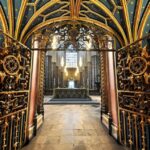
One of the most interesting creative turns on this tour is at the church of St Mary Le Strand. You’ll respond to T.S. Eliot’s study of time, then you’ll do an ekphrasis exercise based on the church’s grand interior.
Ekphrasis sounds like a fancy word, but in practice it’s simple: you describe what you’re seeing in a way that becomes writing—not just noting details. In a big interior space like St Mary Le Strand, you can use scale, light, shapes, and atmosphere to guide your prose.
What makes this stop valuable is that it anchors the Eliot theme to an environment you can actually experience. Time isn’t an abstract concept here. It feels physical—partly from architecture, partly from the long timeline of how spaces get used and remembered.
A drawback to keep in mind: churches can be quiet and sometimes you’ll need to keep your voice low and your writing movements respectful. If you’re hoping for a lively, chatty group moment all the way through, this part asks for a little more steadiness.
Aldwych timeline walls and Eliot’s sense of history
The tour also brings Eliot back through what you can see at Aldwych: a timeline on the walls that echoes ideas about history and time. This is one of those moments where the city teaches you grammar.
In writing terms, this kind of prompt helps you connect individual perception to longer sequences. You’re not only writing about what’s in front of you. You’re writing about how the present sits inside a longer story.
If you’re interested in writing that handles time well—switches, jumps, layers, memory—this segment gives you an external reference point. You can borrow the city’s structure the way a musician borrows a rhythm.





Gladstone and the politics of truth (from Dickens onward)
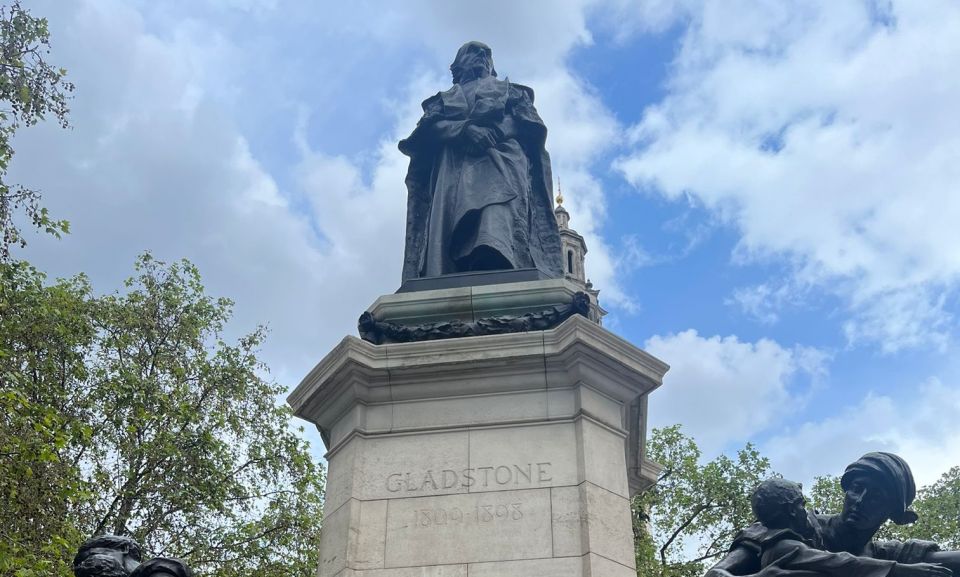
After the church and timeline work, the tour leans into politics, truth, and perspective. You’ll stop near a statue of Gladstone and consider how politics, truth, and history can change depending on where you’re standing.
This is where the tour gets more provocative, in a gentle way. The exercise isn’t about arguing modern political positions. It’s about recognizing that facts and stories move through lenses. Your prompt pushes you to notice that viewpoint changes meaning.
Then Dickens joins the party as another kind of prompt for reflecting on truth and politics. Dickens is great for this kind of writing work because he pushes you toward social observation without forcing you into a single style. You can write with humor, anger, compassion, or sharp observation—your choice.
I like that the tour doesn’t pretend politics is a single topic. It treats politics as human behavior: choices, narratives, accountability, and who gets heard.
Doctor Johnson’s house: language, identity, and a dictionary moment
The final writing engine in the tour is the Doctor Johnson house area. This is where you’ll read from his dictionary and think about how structures like religion, politics, art, and language help shape who we are.
A dictionary reading segment can sound dry. But in this setting, it turns into a surprisingly practical writing exercise. Johnson’s definitions remind you that words are not just labels. They’re cultural decisions. They carry history, bias, and priorities.
Then the prompt broadens: you consider the structures around you—religion, politics, art, language—and how they form identity. That kind of question is useful even if you don’t write nonfiction. It trains you to ask: What forces shaped this narrator? What rules does the character live inside? What language do they trust?
If you care about writing with depth but you also want something concrete to do, this is an excellent closer. You leave with new angles on how to build a voice.
The writing workshop format: what you’ll actually be doing
Across all stops, the pattern stays consistent: you look, you read a little, you respond with writing, and you rethink your draft with a prompt attached to a specific idea.
You can expect:
- Guided prompts tied to each location (so you’re not staring at a blank page).
- Short readings from major English writers used as springboards.
- Questions that help you extend your writing without turning it into busywork.
- Room to make the prompts your own, whether you’re new to creative writing or refining your style.
In other words, the tour respects where you’re starting from. Beginners get entry points. More experienced writers get constraints they can play with.
If you’re worried about being slow, don’t. The exercises are designed to fit into this tight format. Your goal isn’t a masterpiece. Your goal is momentum.
Price and value: is $101 for 1.5 hours worth it?
At about $101 per person for 1.5 hours, the value comes from what’s included and what you do with your time. This isn’t a ticketed attraction where you pay mainly for entry. You’re paying for an expert-led guided experience plus actual writing exercises, with no entry tickets required.
Also, the guide’s credentials matter here. A novelist with a PhD in Creative Writing is exactly who you want running prompts. They understand how to turn observation into usable drafts and how to create a safe learning environment for different comfort levels.
If you’re someone who enjoys learning through doing—especially writing—this price starts to feel reasonable fast. You get multiple literary influences packed into a compact route, and you walk away with writing you made yourself, not just inspiration you hoped would stick.
If you want long pauses, big lectures, or lots of independent wandering, this price might feel steep. But if you want focused instruction and hands-on practice, it’s strong value.
Who this tour is best for (and who might prefer something else)
This experience fits best if you:
- like literature but want a practical way to work with it
- enjoy creative writing prompts and want feedback-like guidance (without pressure)
- want a small-group feel and a guide who creates a welcoming space
- don’t mind writing in public, respectfully and quietly when needed
You might not love it if you:
- prefer purely historical storytelling with no writing component
- want longer time at fewer locations instead of several quick, prompt-driven stops
- get stressed when you’re asked to produce text on the spot
What to bring so you can focus
The tour suggests you bring:
- a pen
- water
- a notebook (it’s implied as part of writing prep)
- an umbrella, just in case
- internet access
That last one is worth taking seriously. Even if you’re not sure why, having a phone with connectivity prevents small friction. And since you’ll be using real-world prompts, being ready with supplies helps you stay in the moment.
Final call: should you book Woolf & Dickens?
I’d book this if you want a smart, humane literary workshop with real place-based prompts. It’s short, but it’s not skimpy. You get Woolf, Eliot, Dickens, and Samuel Johnson feeding your writing brain in a way that feels usable, not decorative.
Skip it only if you dislike writing activities or you’re hunting for a museum-style tour. For the right mindset, this one is excellent value: you get guidance from Joseph, you get structure, and you leave London with lines you wrote yourself.
FAQ
Where does the tour meet?
Meet at the north end of Waterloo Bridge, at the north side slope on the right that goes behind Somerset House.
How long is the tour?
It lasts 1.5 hours.
Is this mostly sightseeing or a writing workshop?
It’s a guided tour plus a writing workshop. You’ll do writing exercises at each stop rather than just listening.
Do I need entry tickets?
No entry tickets are needed.
What should I bring?
Bring a pen, a notebook, water, and an umbrella if needed. The tour also asks for internet access.
Is the tour wheelchair accessible?
Yes, it is wheelchair accessible.
Is the tour led in English?
Yes, the live guide leads the tour in English.