REVIEW · LONDON
London: Street Art and Graffiti Guided Walking Tour
Book on GetYourGuide →Operated by Alternative London · Bookable on GetYourGuide
Street art, explained in two grounded hours. I love starting at Old Spitalfields Market with a guide who brings the East End to life, and I love how the route mixes big names with small details you’d miss if you just wandered. You’ll track roughly 40 acclaimed artists, with works attributed to people like Banksy and others, and you’ll get the stories behind the paint, stickers, and murals.
A heads-up: the art you see is always changing. If a specific wall has been covered since the last tour, you’ll still leave with lots to learn, but your photos may look a little different day to day. Also, bring rain gear and plan for sidewalk time on uneven streets.
In This Review
- Key things you’ll notice on this East London graffiti walk
- Starting at the White Goat Statue: your East End briefing
- Spitalfields to Brick Lane: learning to see the details, not just the headlines
- What makes Brick Lane special on this route
- Shoreditch scenes: spotting artists like Banksy, ROA, Invader, and more
- Why the guide is the whole point of the walk
- Street art changes fast: how to manage expectations and photos
- Workshop option: when you want hands-on graffiti basics
- Price and value: what $33 buys in East London
- Who this tour suits best (and who should think twice)
- Should you book this East London street art and graffiti tour?
- FAQ
- Where do I meet for the London: Street Art and Graffiti Guided Walking Tour?
- How do I get there from Liverpool Street Station?
- How long is the walking tour?
- What’s included in the price?
- Which areas of East London will I see?
- Are specific street artists included?
- What should I bring?
- Is the tour wheelchair accessible and what language is it in?
- Is there a street art workshop option?
Key things you’ll notice on this East London graffiti walk
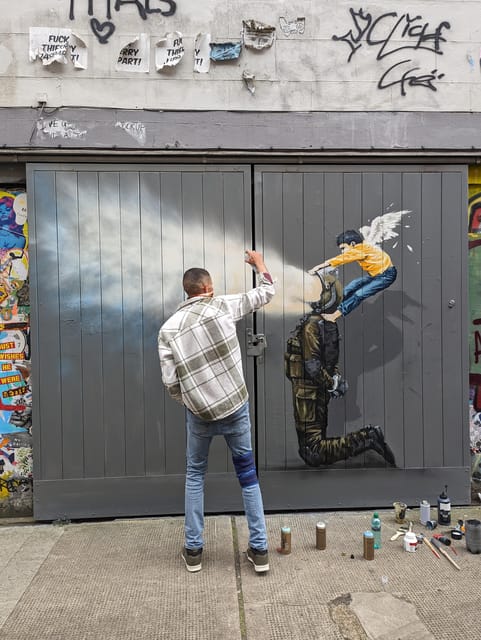
- White Goat Statue start point: You meet under the statue on Brushfield Street, near Old Spitalfields Market.
- Spitalfields to Brick Lane to Shoreditch: The tour maps the creative shift across the East End.
- About 40 artists on one route: Expect major names (including Banksy) plus lots of lesser-seen work.
- More than murals: Tags, stickers, and different techniques are part of what you learn to spot.
- Guides with deep scene ties: Many guides on this tour have worked closely with artists or cover the scene via media.
- Street art changes constantly: The guide adapts, so the walk stays fresh.
Starting at the White Goat Statue: your East End briefing
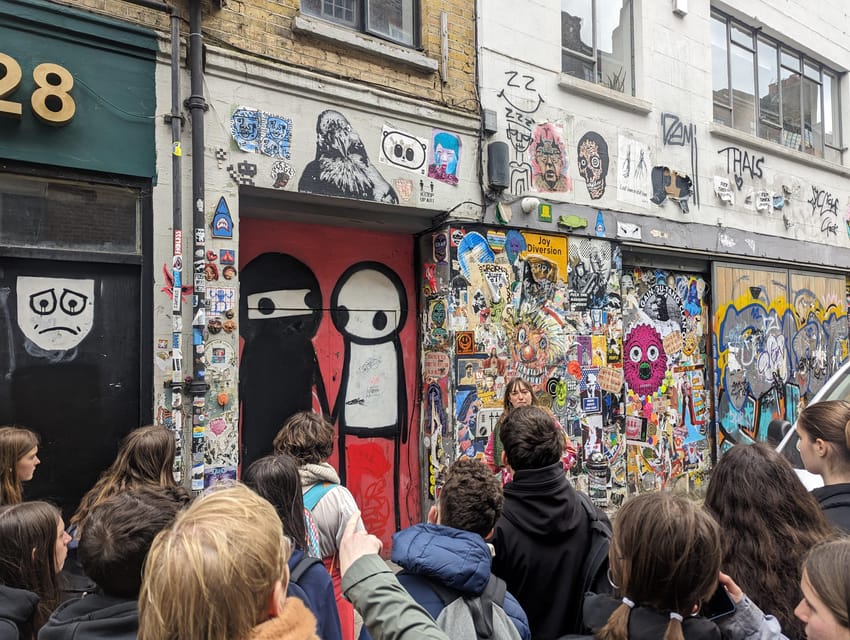
The tour begins in a spot that’s easy to find once you know the trick: meet under the White Goat Statue on Brushfield Street, outside Old Spitalfields Market. If you’re coming by tube, Liverpool Street Station is your closest major stop, and you’ll be walking a short distance from there. Arrive about 10 minutes early so you can catch the group before you head out.
That first minute matters. You’re not just collecting photos. You’re getting an orientation to how East London street art works: why certain areas “hold” work longer, why tags and stickers pop up where they do, and how the look of a wall tells you which era or audience it served. The best part is that the tour treats this as culture, not vandalism-only. One of the guides you might meet, like Josh or Eva, tends to set the tone fast and then keep it moving.
Also, this isn’t a super formal museum vibe. It’s a walking conversation. You’ll be asking questions, pointing out details, and getting the names and context that make the visuals snap into focus.
You can also read our reviews of more walking tours in London



Spitalfields to Brick Lane: learning to see the details, not just the headlines
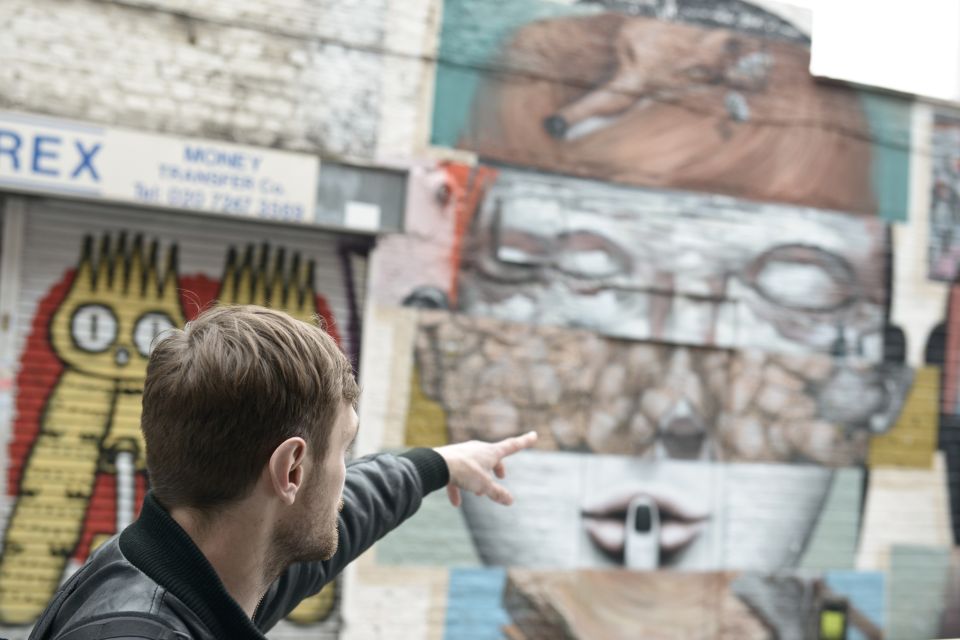
Once you leave the market area, the walk starts pushing you past the obvious. In East London, some art is easy to spot at a glance—big mural faces, bold characters, oversized letters. But the tour trains you to look for the stuff that feels like it’s hiding in plain sight.
On the way to Brick Lane, you’ll spend time on different kinds of street art materials and techniques. You learn the practical “how,” like how stickers function differently from sprayed pieces, and how tags can be about speed, identity, and presence. That technical side is a huge reason this walk feels worth it, even if you think you already know what street art is.
You’ll also get a strong sense of how the East End’s history shaped what people wanted to say on walls. One theme that comes through clearly is that art here doesn’t float above local life. It’s tied to the neighborhoods around it—who’s there, what’s changing, and which communities feel seen.
A nice tempo detail: the tour is listed as 2 hours, but it often lands close to 1.5 hours depending on the group and how questions go. Either way, you’re moving steadily without feeling rushed.
What makes Brick Lane special on this route
Brick Lane can feel like a postcard lane if you only skim it. This tour changes that. Instead of treating it like a single “street art district,” it breaks it into moments—where certain styles show up, what size or placement usually means, and why some pieces feel like landmarks while others are more like whispers.
If you like photography, this is where you start to notice height and angles. One guide described pointing out art on surfaces people rarely check, even things like rooftops or the ground level details. You’ll start doing that too: looking up, scanning edges, and checking corners you’d normally ignore.
Shoreditch scenes: spotting artists like Banksy, ROA, Invader, and more

As the walk continues into Shoreditch, the art tone can shift—more contemporary energy, more street-level urgency, and plenty of styles that mix styles instead of staying in one lane. This part of London is where street art looks like it’s constantly negotiating with the city around it.
The tour is built around works associated with a lineup of acclaimed artists. You’ll hear about names such as Banksy, ROA, Invader, Shepherd Fairy, and Stik, along with many others from around 40 artists in total. The value here isn’t just the name-drop. It’s understanding why each artist’s style works and what audiences take from it.
One reason the walk feels different from a casual “look and go” is that the guide usually explains emotions and intention—what the piece is trying to communicate, and why it’s placed where it is. You’ll be able to look at the same wall again after the tour and see more layers: technique, message, and local meaning.
And yes, there’s a realistic chance you’ll spot something that gets you that instant wow reaction. Some guides have even been described as helping people notice a Banksy sighting as part of the walk. Since street art changes fast, I’d frame it like this: the tour is designed with these artists in mind, and the exact walls can shift, but the route keeps you pointed at the right kind of art.
Why the guide is the whole point of the walk
Street art is visual. But it’s also coded. Without context, you can still enjoy it. With context, it turns from decoration into communication.
This tour is led by a guide who’s deeply connected to the scene—some guides have worked alongside artists or shown the art on podcasts tied to the world of street art. In plain terms: you’re not just getting talking points. You’re getting a local translator.
You’ll hear clear explanations about:
- how tagging and graffiti culture operates
- the mindset behind different styles
- why certain techniques show up in certain places
- how artists’ backgrounds shape their visual choices
The guides also tend to be friendly and responsive. Several of the named guides in recent departures—like Laura, Ava, and Natalie—are described as asking questions, tailoring the walk to what the group is curious about, and making room for discussion. That matters if you’re a beginner. It also matters if you already follow street art culture, because you get more than surface-level trivia.
One thing I especially like about this format is that the guide helps you learn how to spot quality in the city. After two hours, you’ll start recognizing patterns elsewhere in London—different signage tags, poster styles, and how street art “brands” its territory.
You can also read our reviews of more guided tours in London





Street art changes fast: how to manage expectations and photos
Street art constantly shifts. New work appears. Old pieces vanish behind fresh paint or get covered for redevelopment. So you need a mindset that matches the subject.
The tour handles this in a practical way: the guide adapts the walk so it stays current, and the overall experience stays focused on learning how to look. That means you shouldn’t treat it like a guaranteed checklist where every exact wall is identical every day.
For your photos, think less like a collector trying to document a perfect archive, and more like a student capturing moments you’ll later understand. If you take pictures, include a bit of your surroundings too—street corners, doorways, and placement—because the placement is part of the story.
Bring rain gear too. London weather loves to test your plans. Even if it’s just a light drizzle, it can change your comfort on a two-hour sidewalk walk.
Workshop option: when you want hands-on graffiti basics
This experience also comes in a combined format with a street art workshop. The shorter workshop is available daily for ages over 10, and there’s a longer option for over 12 that includes a break within the half-day version.
Why this matters for value: a guided walking tour teaches you how to see and why it’s there. A workshop gives you a way to make. If you’re the kind of person who learns faster by trying, the add-on can turn your “I get it now” feeling into something more physical and memorable.
If you’re traveling with a mixed group, you can also book so some people do the workshop while others do the walk that day—just make sure any under-16s are accompanied by an adult throughout, since that’s a stated rule for the workshop portion.
Price and value: what $33 buys in East London
At about $33 per person for 2 hours, this tour sits in the “good value” zone for London. It’s not just a generic walk. You’re paying for:
- a guide who can connect street art to East End history
- context for major artists and local scene styles
- help noticing details you’d almost certainly miss alone
- a route that concentrates on the creative spine of East London (Spitalfields, Brick Lane, Shoreditch)
If you’re considering paying for a street art tour in a city where art feels like background, this one makes the art feel legible. You leave with names, techniques, and neighborhood context. That’s harder to achieve on your own, because the important parts are in the explanations and the “where to look” training.
And you get a strong bonus in the form of consistency. The tour is designed to stay fresh because the street art changes, so the guide has reason to evolve the route instead of repeating the same script year after year.
Who this tour suits best (and who should think twice)
This is a great fit if you:
- love street art but want the stories behind the spray, stickers, and murals
- want to walk through East London with a plan instead of winging it
- like learning culture through real neighborhoods, not just monuments
- travel with teens or friends who might enjoy a creative angle (several guide stories highlight how teens get inspired)
It’s also a smart choice if you’ve done other “graffiti tours” that felt like a photo hunt. Here, the art is explained in a way that helps you look better after you go.
Think twice if:
- you need totally predictable, exact locations for specific murals every single time (street art doesn’t work like that)
- you’re expecting a quiet, sit-down lecture. This is a walking, asking-questions style experience
Should you book this East London street art and graffiti tour?
Yes, if you want London street art to make sense fast. Starting at Old Spitalfields Market, then moving through Brick Lane and Shoreditch, this walk gives you a tight, enjoyable structure for spotting real street art, understanding the culture behind it, and learning why the East End paints the way it does. The guide-led format is the difference-maker, and the $33 price feels fair when you consider how much context you’re buying.
If your goal is to enjoy street art on your own without explanations, you could wander. But if you want the “why” as much as the “what,” this is the kind of tour that changes how you see the walls long after you’ve left the neighborhood.
FAQ
Where do I meet for the London: Street Art and Graffiti Guided Walking Tour?
Meet under the White Goat Statue on Brushfield Street, outside Old Spitalfields Market. The closest station is Liverpool Street Station. The guide will be under the statue with a white goat on top.
How do I get there from Liverpool Street Station?
Exit Liverpool Street onto Bishopsgate, walk left, then take a right onto Brushfield Street (between Pizza Express and the RBS building). Walk about 100 meters up Brushfield Street. The guide is under the White Goat Statue.
How long is the walking tour?
The guided walking tour is 2 hours.
What’s included in the price?
The price includes a live tour guide.
Which areas of East London will I see?
You’ll walk from Spitalfields over to Brick Lane and then into the Shoreditch area.
Are specific street artists included?
Yes. The highlights include street art from around 40 acclaimed artists, including Banksy, ROA, Invader, Shepherd Fairy, and Stik.
What should I bring?
Bring rain gear. Comfortable clothes and shoes are a good idea for any walking tour in London.
Is the tour wheelchair accessible and what language is it in?
The tour is listed as wheelchair accessible, and it runs with an English-speaking guide.
Is there a street art workshop option?
Yes. The activity is available as a combined walking tour and street art workshop, with a shorter workshop option (45 minutes to 1 hour) and a longer version that includes a break.